lundi 14 octobre 2019

Movie representation of the ''Last of the Mohicans'' compared to historical illustrations of First Nations

Hello!

I recently watched the movie ''The last of the Mohicans'' from Michael Mann released in 1992 with my historian boyfriend Michel Thévenin, author of the blog Tranchées et Tricornes. He posted two articles linked to the movie: one article  about the representation of the techniques of siege war and the other about the redition of the fort William-Henry (both only available in French, but you can use the Google translate installed on the page).

The thing that catch my eye during the viewing of the movie was how Native Americans were represented. The representation is almost uniform according to which European side the Nation is allied to; the main characters (British in the movie) or enemies.


In this movie, the First Nations are shown as allies of the British (Mohawks) or enemies of them (Hurons). In a quite subtile way, that duality is also shown in the clothes the people of the different Natives Americans wear. The enemies (Hurons) are shown wearing almost only the breechcloth and the mitasses. So they are almost naked, making them seem more   ''savages and unpredictable .'' On the other hand, the ''good'' allies are almost always wearing a shift over their breechcloth and theirs mitasses tend to be longer. The Mohawks represented this way look more ''civilised'' because their clothes are closer to the Europeans' one. The quotation marks are big because I want to emphase that it does not reflect my personal opinion. I think we do not know the what the Nations were then, and we know very little of the actual dress of period First Nations.

The three heroes of the movie are from the Mohican Nation, I will talk about them in the end of my article.


If the Native Americans clothing in this movie is acceptable from a historical point of view, the tendency of uniformisation of all people of the same Nation according their allegiances is more to have an impact on the narrative than to have an adequate representation of every Nation they represent.


I had almost no idea on how the Huron and the Mohawks were dressed in the 18th century so I made a search for 18th century drawings and paintings of these Nations. I wanted to know if the Michael Mann film was depicting Natives according to the 18th century iconography.


First, let's have a look ay the Hurons, the ''bad guys'' in the movie.

Here are the selected screen shot.


Magua and Hurons during the capitulation of fort William Henry
Magua and Hurons in ambush

Hurons in ambush from back

Magua and Hurons about to capture British survivors
Returning to the Huron village with British prisoners

Nathanael presenting himself to the Huron village

To be fair, the more the Hurons are depicted close to their village, more of them are wearing shifts. The naked representation of the Hurons is more because they were at war almost all of the movie. The more they are into a ''civilian'' context, the more shift they wear. War outfit are supposed to inspire fear of the opponent. That's why the Hurons are almost all the movie shown shirtless. That also make them look more ''primitive'' more ''close to nature''.

How are Hurons depicted in 18th century documents? I only found two sources illustrating the Huron Nation.


Hurons of 1710
From the City of Montréal Records

If this representation is closer to the movie, note that it is about 40 years earlier. The movie ''The last of the Mohicans'' takes place is in 1757 and this engraving is dated 1710.


Watercolor representing a Huronne and a Huron
vers 1750-1770
From the City of Montréal Records

This painting is closer to the same time as the siege of Fort William Henry (called fort Georges by the Frenchs). The Hurons shown are located at the Lorette village, near Québec City. (Forget the Huron village in the area of Fort William Henry that is shown in the movie, it is an geographical error)

The man wears a long shift with ruffles,  metal jewelry in the ears, the chest' and on the arm. He also wears mitasses and mocassins. His clothing is covered by what can be a blanket but could be a piece of clothing that I am unfamiliar with. That man is visually different from the Huron warrior Magua, who wants the death of ''Grey Hair'' and his family during all the movie.


Second part, I compare the Mohawks of the movie with 18th century representations.


Mohawk Chief pledges allegiance to the British King

Mohawks waiting in the fort William Henry
Mohawks,  British soldiers and civilianson the edge of the du fort William Henry during negotiations of the capitulation


Mohawks in the group of people evacuating the fort
In pink: Mohawks
In white: the three Mohicans

Mohawks in the group of people evacuating the fort
In pink: Mohawks
In white: the three Mohicans

In the screenshots I have chosen, there is only one shirtless Mohawk visible on the last one, third circle from the right. There are two more scenes that I decided to not include because of their peculiar context. The scene where Mohawks and British pionners play baggataway (ancestor of the  Lacrosse game) where all players are shirtless, and the scene were Nathanael sleeps in the same room as the Mohawks and is awoken by British soldiers. Being shirtless is in the first occurence is part of the game and in the other it is a sleeping outfit. Nobody dress the same at night than during the day. Those scenes were not representatives of daily Natives clothes in my mind.

Most of the 18th century illustrations I have found do not describe Mohawks (Or Agniers in French sources) precisely but their Nation Family the Iroquois Confederacy. It is a difficult thing to talk about First Nations especially when it is not a subject well known to me. I know little about the differences of the Nations and Tribes. Thanks To Cathrine Davis to look at my texts for the content and the sentences of this article. Your anthropologic analysis helped me to have a better understanding.

The Iroquois Confederacy was  an alliance of 5 Nations and existed as early as the 16th century. Members nations were the Senecas (also called Tsonnontouans ou Sonnont8hronons) , the Cayugas (Cayougas, Goyogouins or Guyohkohnyos) , the Onondagas (Onontagués or Onondagues), the Oneidas  ( or Onneiouts), and the Mohawks  ( Kanien'keha:ka, Agniers or Maquas). To these five Nations another group joined during the 18th century, officially in 1722, the Tuscaroras ( Touscaroras). These Nations have similar linguistic  ( Iroquois speaking) and material caracteristic' but are still a different from one Nation to the other. They built Long Houses and they are matrilineal.


Fun fact: Hurons are also speaking an Iroquoian language but they lived farther away and did not joint the Iroquois Confederacy, so they are considered a different group.


Most of the 18th century pictures I have found describe the Iroquois without specifying their specific Nation.

Another thing I have to say. I have not found the context why those pictures were made in the first place: frighten Europeans or just to inform them? Does the artist was in contact with the tribes he draws or was having description from another person? I have not look for the answer to those question. My goal was to find 18th century images of Amerindians. I think those pictures are the closest look we can have of real 18th century Amerindians. Cathrine Davis wrote me that they are in a book called ''Costumes of the World'' published in the later 18th century. We think the book was meant for entertainment as well as for education.


Sauvage Iroquois, 1736?
From the City of Montréal Records
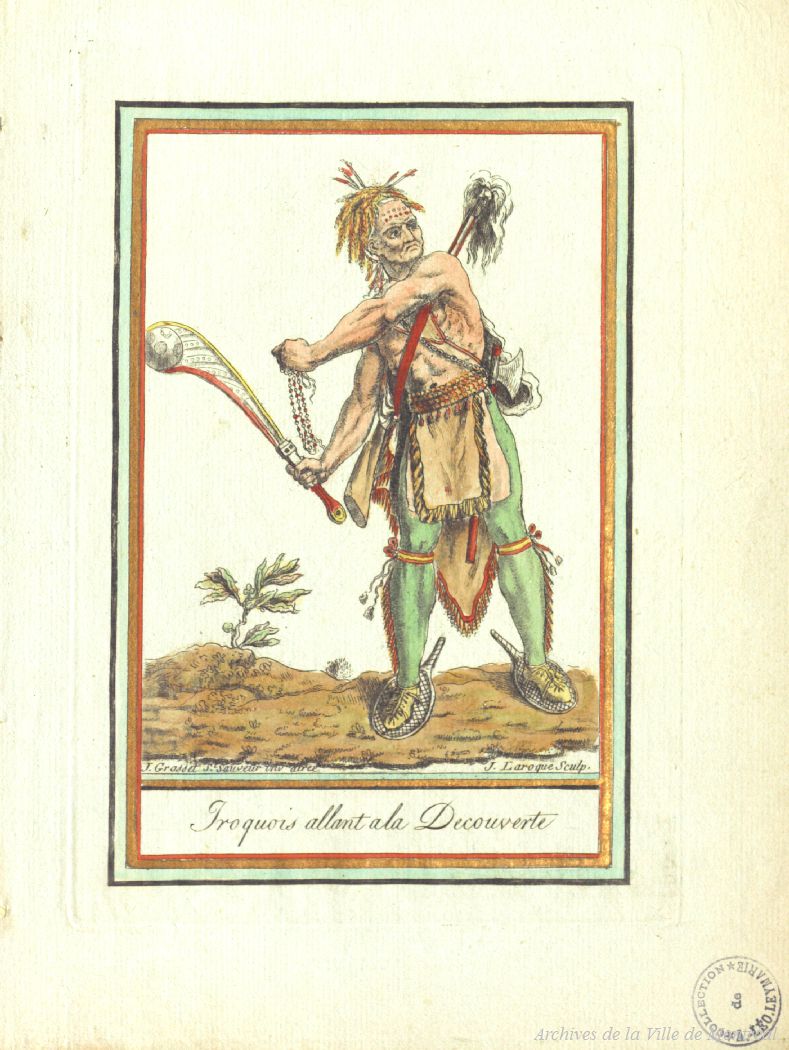
Iroquois allant à la découverte, 1739?
From the City of Montréal Records

Guerrier Iroquois, 1746?
Tiré des Archives de la Ville de Montréal

Grand Chef de guerriers Iroquois, 1744?
Tiré des Archives de la Ville de Montréal
Those four engravings shows mostly breechcloth and mitasses, plus lots of accessories. The Mohawks in the movie are not represented this way. The last picture is a Great Iroquois War Chief and he wears only a shift under a nicely decorated ''justaucorps'' (coat). He also wears a decorative belt and a medal on a ribbon. The Chief in the movie only has a blanket over his shirt to distinguish him. A little less impressive.


Next paintings are paintings of known Mohawk Chiefs.

The Chief Mohawk
Thayendanegea or Joseph Brant,
 painted by Gilbert Stuart, 1786
Wikipedia
Joseph Brant was more active during the American Revolution than during the Seven Years' War because we was teenager during the Seven Years' War. He was a loyalist, on the British side during the conflict of the thirteen colonies against Great Britain. More details about his life on the Canadian Encyclopedia, follow this link.

No Mohawks in the movie wears those metal rings or have a feather headdress. In fact, no headdress is visible on any First Nation during the movie.


Sagayenkwaraton,  King of Maquas, Iroquois
Artiste: John Verselst
1710
Bibliothèque et Archives Canada
This portrait is really interesting for many reasons even if it is dated 1710. A delegation of four Native American Chiefs went to London to ask for the help of Queen Anne of England to ally against the French and their Natives Allies. The London population called them ''the four Indians Kings''. They were welcomed as noble delegates and went to the court. Queen Anne commissioned a portrait of each of the four '' Indians Kings''. More information about those paintings into this  article , on an ancient exhibition about it.

Of the four ''Indian Kings'' on those portraits, the King of Maquas (Mohawks) is the one with the most tattoos. He just wears a shirt ans a knotted belt around the hips. His mocassins are decorated, it may be pearls or embroidery. He wears a decoration around the ears that look like sheep wool or swan's down. The red blanket was a gift of the Queen Anne who wanted them to be represented as royalty. Timeframe for this painting is the same of the first engravings about the Hurons, it is about forty years in advance of the conflict shown in the ''Last of the Mohicans''.


Lastly: the three Mohicans of the movie. Mohicans are form Algonquin family the same way Mohawks are from Iroquois family. The Mohicans are wearing more or less the same outfit as the Mohawks in the film, despite coming from another Native family.

En avant-plan: les trois Mohicans

Their shirts are coloured to make them easily recognizable. They wear long mitasses and a breechcloth.

The only illustration of the Mohican Nation I have found is one of the ''Four Indians Kings'' that the Queen Anne commissioned in 1710.

Etowaucum, Roi de la Nation de la Rivière, Mohican
Artiste: John Verselst
1710
His saber at the waist and the mace in his hand represent his warrior competences. He has a subtle tattoo on his face. He wears a simple shirt and mocassins.


This is what I wanted to highlight with this article:

  • The different Native Nations of North America are not well known to the public, myself included
  • First Nations did not have uniforms, their representations in historical sources tend differ from one source to the other and from one Nation to the other 
  • The Native Americans shown in the movie ''Last of the Mohicans'' are there to serve the narrative rather than being based on the pictures from the 18th century 
I have to mention that the ''Last of the Mohicans'' is better than most Hollywood stereotypes of Natives, showing them wearing fabric instead of leather. Many adopted fabric easily through trades with Europeans.


What I was expecting to find was a representation of Natives wearing pelts to keep them warm during the winter. Maybe it is because it is winter clothes that they were not represented. I feel like I should do an article about fur pelts to deep more that topic.

To finish, I want to share two others Nations that I did not have the opportunity to show above, to underline the diversity of Native clothing!


Watercolours representing Abénaquis
Aroune 1750-1780
From the City of Montréal Records


Watercolour representing Algonquins
Around 1750-1780
From City of Montréal Records

I hope that you enjoyed this article! I stepped outside my comfort zone to produce it. A special thank you to Cathrine Davis to help my English mistakes. They were plenty.


Mlle Canadienne


samedi 28 septembre 2019

Mid 18th century Hairstyle step-by-step

Hello,

I promised to make an article about woman hairdressing of the 18th century into the last photoshoot article I made (in French only): Séance photo de août 2019. So here it is!

The knowledge I have for 18th century hairdressing and caring comes from three sources. 

Mme Evelyne Bouchard initiated me when I was part of her group:  In Memoriam. I read also the  American Duchess's book: The American Duchess guide to 18th century beauty.  I read the website of  Mr. Alain Ducher. He got the title of  ''meilleur ouvrier de France'' for his  Manuel de coiffures historiques, where he recreates hairstyles form all historical period.

I also read the Toilette de Flore (in original French) of 1777 written by M. Pierre Joseph Buc'hoz about powders pomades and perfumes. 


The powder is amidon base. It can be wheat, rice, potato or other. The finer and the whiter, happier the consumer. To the starch can be add ashes, crushed shells or bones, odorant roots and perfume. The powder is the main care product to clean the hair. It can be use alone for the poorer of with pomatums for the wealthier. According to Mr. Alain Ducher, woman were also ''leaching'' their hair but I haven't found it somewhere else. He says that it is not the washing process itself that scared people but the idea of having a wet head for long time, almost synonym to death during winter. So ''leaching''the hair was done only in summer. 

The pomade, based with mutton and or pork fat, deeply washed and infused with perfume makes the hair more malleable. It fixes the hairstyle.

The hairstyle made into the following picture is the fashion of the 1750's period.

Most of my beauty accessories come from The Lady behind LBCC Historical. (Orange water, white makeup, Rouge liquid, hair pomade, Hair powder)

I am testing the pomades and hair powder of my friend Nick Barber. His main domain is blades, razors, axes and all sorts of sharp things.


When we made the picture, my hair was living the 18th century life for 24 hours. They were pomaded and powdered for that time period.


Hygiene, hair care and makeup things.


First step

Untangle the hair with combs. It removes the old powder from the hair.


A horn comb freshly used


Second step

Put pomade and powder into the hair. During the photoshoot, my hair was full of pomadums and lost powder during brushing. I just added powder.


Third step

Make the separations of the hair. It is for this step that I would need a lady to help me (Cathrine Davis you miss me, Virginia is far...)The front of the hair is separated with a line that comes from one ear to the other. This separation is divided in half in the middle of the front. Most of portraits of the period shows littles frills of hair or little rolls of hair. My hair is too long to make frills and I miss talent and patience to make the feminine small rolls on my head so the front is boring according to the period criteria. My hair is gathered into a bun that is on the front top of the head. According to 2019 criteria, it is really in the front area and it feels weird the first times. (my older pictures shows that I was not making the bun on the front enough and it makes the hairstyle a little off when compared to portraits. 


For the back of my hair, I was inspired by the back of the bust of Mme de Pompadour. It is three braids raised in the bun direction. 

Sculpture of Mme de Pompadour
by Jean-Baptiste Pigalle
1748-1751
Exposed at the Metmuseum de New York


Make the separation is difficult
Fourth step
Braid the back hair.


I won't thrust Joseph again to tell me if the separation is straight or not. He said is was straight. Men and fashion... 

Finishing the third braid

Fifth step 

Make the flat bun in a way that it will be hidden by the cap. Raise the braids unto it.


Flat bun is appropriate for the period from 1730 to 1760, more or less. Before, the main hairstyle is ''à la Fontanges'', after begins the reign of the ''pouf'' of Marie-Antoinette.

Les tresses sont toutes remontées


Sixth step étape

If wanted, add another layer of powder. 


The ''houpette'' is practical to layer powder to the hair.
It can be made in swan feather but this one is made in long hair sheep skin.

Make a uniform layer is not as easy as it seam.


Last hairdressing step

Hide the bun with the cap.


The hairstyle is done!


Now is time to talk about historical makeup

The foundation, was named ''pommade pour le teint'', I have not look for the original English name. It is that pommade that was sometime using lead into it. ''Blanc de céruse'' or lead oxyde, had the reputation to be whiter than white and now is known to be harmful for the skin. According to American Duchess, they did know it too back then. (It is the same as the use of the cigarette today, it is known to be harmful but people keep using it). There are recipes that is not using lead and they are the reproduction sold today.

Red comes into a liquid form and simply state that ''red imitates the natural'' The same product is use for the lips and the cheeks. The Liquid Rouge I have is drying my lips, I should invest into a hydrating historical lib balm.

Burned cloves are used to darken the eyebrows.


A thin layer of powder ends the makeup and give to the skin a  velvet peach skin aspect.

Many people talks about blue to fake veins but I have not found it into historical sources yet.

Mouches, those little piece of black silk can be add to accentuate the paleness of the skin. A dark ribbon around the neck does that effect too.


The first time I tried to make an historical makeup, I looked like a ghost with two caterpillar instead of eyebrows. To know how to dose is a difficult art...


I have not found the good tools to spread the white make up. The texture of it is rather thick.

It is not the most successful makeup I have made...


A good view of the hairstyle.


With time the makeup tends to fade away, giving a more natural look.


That ends my article about 18th century hairstyle and makeup.

I want to officially thank my good friend Joseph Gagné, historian and author of the blog Curious New France. He was the photographer that morning. Without Joseph, my separations of hair would have been more wavelike and I would not have been able to make this article.


I hope you liked this article!


Mlle Canadienne

Pet-en-l'air, tracing back the origins of the expression

Hello!

At the end of the article about the art of farting, I said that I believed that the book ''L'art de péter'' was the first mention of the expression ''Pet en l'air''. My historians friends helped me to retrace that expression before 1751. A special thanks to those friends: Joseph Gagné from the Blog Curious New France for looking into his dictonnary ef ethymology and to my boyfriend Michel Thévenin from the Blog Tranchée et Tricorne to help in this research.


First finding: Dictionaries does not always contain all the usable words. I should have guessed that because the word ''pet-en-l'air'' has been retired from the official dictionary of french in 2018, juged too old and not used. See this video of the  ''Journal télévisé de13Heures'' of France2 aired in 15th November 2018 .

So the dictionary does not always contains all the words used of the period it is published.


Modern dictionaries seem to have retained that ''pet-en-l'air'' is a short ''paletot'', in other words a kind a loose fit vest, unisex and comfortable. (Traductions of the definitions of the Larousse dictionary, found online)

The research that lead to the writing of this article, I found a dictionary that contains the definition of the ''pet-en-l'air'' dating from the 18th century: Nouveau dictionnaire universel des arts et des sciences, françois, latin et anglois (1756). Weirdly, this definition does not fit the famous one of M. de Garsault who wrote that a ''pet-en-l'air'' is like a dress but only shorter. This 18th century dictionary definition is more alike the one of the modern Larousse dictionary. This 18th century dictionary is edited in Paris, France.

Page 212
''bedgown that goes only to the knee''
Dictionnaire universel des arts et des sciences, françois, latin et anglois (1756)


Second finding: My history idiom works: one source is good, two is better.. But plenty is the best!  See the article about mantelet to read the first enonciation of my history idiom. Because I wanted to share rapidly my discoveries, I got wrong into the article about the art of farthing: 1751 and the ''Art de péter'' is not the first written place where the expression ''pet en l'air'' is seen. 


Third constatation, and a deceptive one for me : the ''Art de péter'' did not influence the fashion to make the name of the feminine piece of clothing described by M. de Garsault in 1769. It was too good to be true.


This is the result of my research to document all the sources mentionning the expression ''pet-en-l'air'' that appeared before 1751, when the ''Art de péter'' was published. Because I thought it was the fisrt mention of the expression.


1631, the first time I found the expression

The earlier I found the ''pet-en-l'air'' expression is in this book from 1631, published in Rouen, France:  Histoire générale de Normandie, contenant les choses mémorables (...), par M. Gabriel Du Moulin, Curé de Maneual.


In this book, the expression means gesture of showing the cheek of the bum. is has no relation with clothing. Because the gesture is not further detailed in the book, I want to share my interpretation of it. To make the gesture of a ''pet en l'air'', you have to slip down your breeches, trousers, pants or whatever you wear on your hip to put your bum into the air and then fart as loud as you can.


On the top of the roof: five bums making a ''pet-en-l'air'' in place of the canons commanded by the Prince Pet-en-l'Air to welcome the Amazone emissary
Extract of  Art de péter, edition of 1776.


1685, second mention of the expression 


Between 1631 and 1685, I have not found another mention of the expression. The second time it appears in my research is in a collection of funny and burlesque plays It is called: Recueil des pièces du temps ou divertissement curieux pour chasser la mélancolie & faire passer le temps agréablement, contenant vingt pièces burlesques & facecieuses. This book is published at La Haye, in Holland.


It was not easy to understand the meaning of the sentence. According to my understanding: the character of this play is a noble who has been awoke by a huge fart of his valet in the beginning of the play and the ''pet en l'air'' is the last sentence of the play. I think that it refers to the manner the character was awaken in the beginning of the play but the sentence is so confusing that it could mean another thing. Another way to understand the sentence is no matter your reputation, if you ''pet en l'air'' (fart into the air) your name will be a disgrace.  I think that ''pet en l'air'' mentions an action like the first one.


Le Mercure Galant editions of 1728 et 1729,  first source of naming a piece of clothing called a ''pet-en-l'air'' 

In only one year apart, two definitions of a piece of clothing called ''pet-en-l'air'' appears.

The first apparition is in the description of a play and the ''pet-en-l'air'' is a masculine piece of clothing. The character who wears it, '' Lyncée'' is a man. This description appeared into the Mercure de France of July 1728

The ''Mercure de France'' is edited in Paris, France.


At night, the male character appears on scene with a lantern in his head and a night cap. This context makes thing about a nightgown for man, like the 1756 description of a short nightgown for a ''pet-en-l'air'' into the dictionary. 


Next year, 1729,  the same magazine talks about another ''pet-en-l'air'' and describe a of clothing for woman like the description of M. de Garsault. If it is a game of who came first, the man banyan ''pet-en-l'air'' came one year before the pretty woman one.


Into the end of the piece description there is another mention of a ''pet-en-l'air'':


The main character is a woman. She wakes up to realize that someone cut her dress and transformed it into a ''pet-en-l'air. 1729 is, according to my humble research, the first mention of the feminine ''pet-en-l'air'' as described by M. de Garsault into the Art du Tailleur of 1769.


Extract of L'Art du Tailleur, 1769
François-Alexandre-Pierre de Garsault
This is the most reported written description to claim what is a ''pet-en-l'air''


1728 à 1751: Different clothing for both sexes


From now, I regroup the mentions of ''pet-en l'air'' by the gender who wears it. I finished my search around 1751 because it is the date I thought it was the first mention of a ''pet-en-l'air'' before that search. 

Let's begin with menswear:

The first man mention has been seen above, in the ''Mercure de France'' of 1728. Here are the other findings:

-1741 into a fairytale called  Le prince Courtebotte et la princesse Zibeline, from Fééries Nouvelles of the writer Anne Claude Philippe de Tubières de Lévis Comte de Caylus. This book is published in La Haye, Holland.

Little fun fact about that book. the author clearly claims that he did steal the fairytales he publish to explain why the last one is not finished. Editing world is a fascinating one, even almost 300 years ago! 


The king of the story when the queen is finally giving birth to their child in the middle of the night just put on a ''pet-en-l'air'' and slippers. and went to the queen's appartement. But He could not make it in time.


-1745 in another fairytale called La princesse Azerole ou l'excès de la constance, into the book called Cinq contes de Fées. The place of printing is unknown.


Turlupin is a man character depicted as the fool of the castle, He wears a ''pet-en-l'air'' made in a fabric that has been dyed many times. It is more plausible that the guy wears a man's clothes designed for night during the day than a woman's day dress. Travesty was not an acceptable thing back then.  


Now the mentions that designed woman's clothing:

-1731 a woman ''pet-en-l'air'' appears into the play  Arlequin Bellerophon  from Nouveau Théâtre Italien from an author collective. It is printed in Paris, France.


One of freshly captured Amazons says about another woman that if she conquered the heart of the man that captures them only wearing a ''pet-en-l'air'', she must be redoutable when fully armed! 


This mention is not very descriptive as the one of the Mercure de France in 1729. It is only associate with a woman. I assume that the piece of clothing is supposed to be seen in public. 


-1742, another ''pet-en-l'air'' for woman appears into a litterature review. It talks about the queen of bees wearing a different piece of clothing that the workers bees or the flys. Found into the Bibliothèque Françoise ou Histoire Littéraire, tome 35, seconde partie. That book is published in Amsterdam, Holland.


The queen of bees wear a ''juste'' or one of those short piece of clothing that Ladys called a ''pet-en-l'air''. Why insects are wearing human clothes, I did not read enough to understand. But that description from Holland is more descriptive, classing the ''pet-en-l'air'' into the same category of the ''juste''.

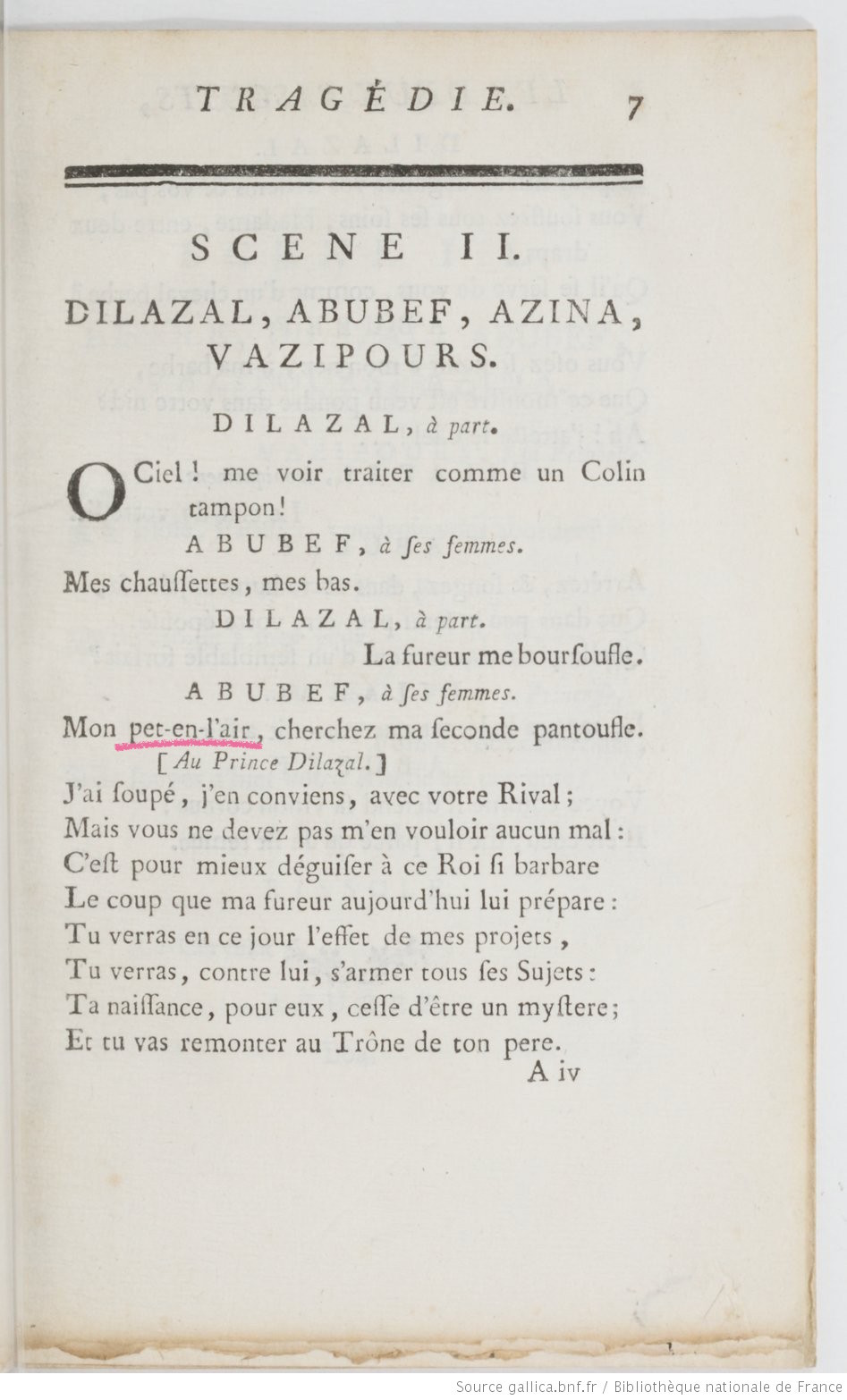
-1749 , the woman ''pet-en-l'air'' appears in the second scene of the tragic play called: Les deux biscuits. The editing place is not mentioned but it is sold at Astracan.


The context of the play is simple. Abubef, a noble Lady, is requiring pieces of clothing to her domestics and asks for a ''pet-en-l'air''. 


1752, it is one year after the timeframe I gave myself but the mention of the ''pet-en-l'air'' of that book is too cool to not talk about it, It appears int the Réflexions critiques sur les différentes écoles de peinture written by M. le Marquis D'argens, Jean-Baptiste Boyer. The book is published in Paris, France.


 The author is talking about the images of the Church and would like to see Adam chased from paradise wearing a ''redingote'' and Eve a petticoat and a ''pet-en-l'air''.


One mention is in between the two above description


To make people more confused about the different piece of clothing, in the previously mentionned  Nouveau Théâtre Italien  of 1731, another play uses the word ''pet-en-l'air''. In the play  Méchante Femme, the ''pet-en-l'air'' is a synonym of a ''manteau-de-lit'', an indoor piece of clothing for woman. A kind of woman banyan if you like. 


Conclusion

In the 17th century,  ''pet en l'air'' is reffering to an action and not to a piece of clothing. All sources are from France and Holland.

In 18th century, no action mentions. The first piece of clothing described by the name ''pet-en-l'air'' in 1728 is the man banyan type. The description that fits the one made by M. de Garsault in his  Art du Tailleur (in 1769) appears one year after. Even if the word appears in the books I mentioned above, they are few. It tend to prove that the word ''pet-en-l'air'' was not a very popular one in the first half of the century.  


The resume of my pet-en-l'air findings in ancient books


From the 1760's and after, the mentions of a feminine ''pet-en-l'air'' are really more frequent. I wanted to document the early apparition of the word until the half of the century so I did not keep the later mentions. All the books in this article comes from an European context, mostly from France. but some from Holland.

From my perspective, dictionary will preserve the banyan description of the word and fashion will preserve the woman piece of clothing described by M. de Garsault.

I think I proved my history idiom:  one source is good, two is better.. But plenty is the best! 

Thank you to have read me until the end!


Mlle Canadienne


A special thank you to my friend Cathrine Davis to help me with my English sentences.


4-Ceintures fléchées: l'utilisation de laine européenne par les Premiers Peuples de l'Amérique du Nord

 Bonjour! Voici la suite à propos des sources autochtones, ici référant exclusivement de l'utilisation de laine colorée européenne par l...